
DURGAM CHERUVU MASTERPLAN, HYDERABAD
Regenerating Durgam Cheruvu — Urban Oasis Masterplan, Hyderabad
Studio Symbiosis, the international architecture and urban design practice led by principal architects Amit Gupta and Britta Knobel Gupta, presents the regeneration of Durgam Cheruvu — a 352.58-acre lakefront masterplan for Hyderabad conceived at the intersection of ecology, culture, and computational design.
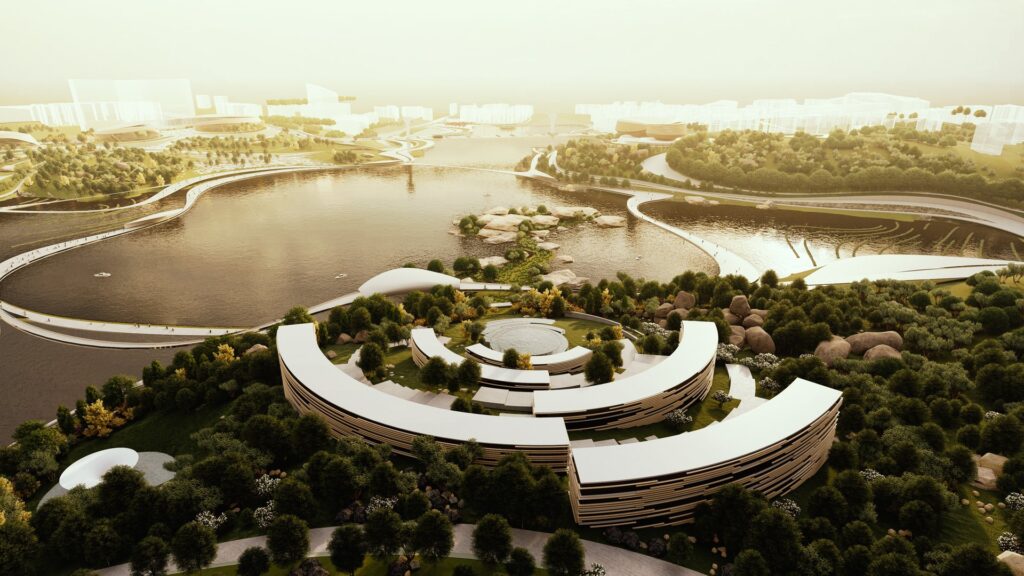
Set within the evolving urban fabric of Hyderabad, the regeneration of Durgam Cheruvu reimagines the lake as a performative urban landscape — an immersive oasis aiming to reconnect the city with its ecological and geological roots. Conceived as a dialogue between nature and urban life, the project transforms an underutilised natural asset into a vibrant public realm that enables recreation, culture, and collective experience. At its core, the intervention is driven by the idea that design must emerge from the site itself, responding to its terrain, water systems, and existing biodiversity to create a seamless integration between the built and the natural.
Envisioned as an inclusive destination, the project caters to a diverse user base — from millennials and Gen Z to families and tourists. A layered mix of cultural, recreational, and social programmes ensures activity throughout the day and into the evening, with high-energy attractions balanced by quieter, contemplative spaces. These programmatic anchors are distributed across the site to create a dynamic and consistently active public realm.
A City Reconnected to Its Natural Edge
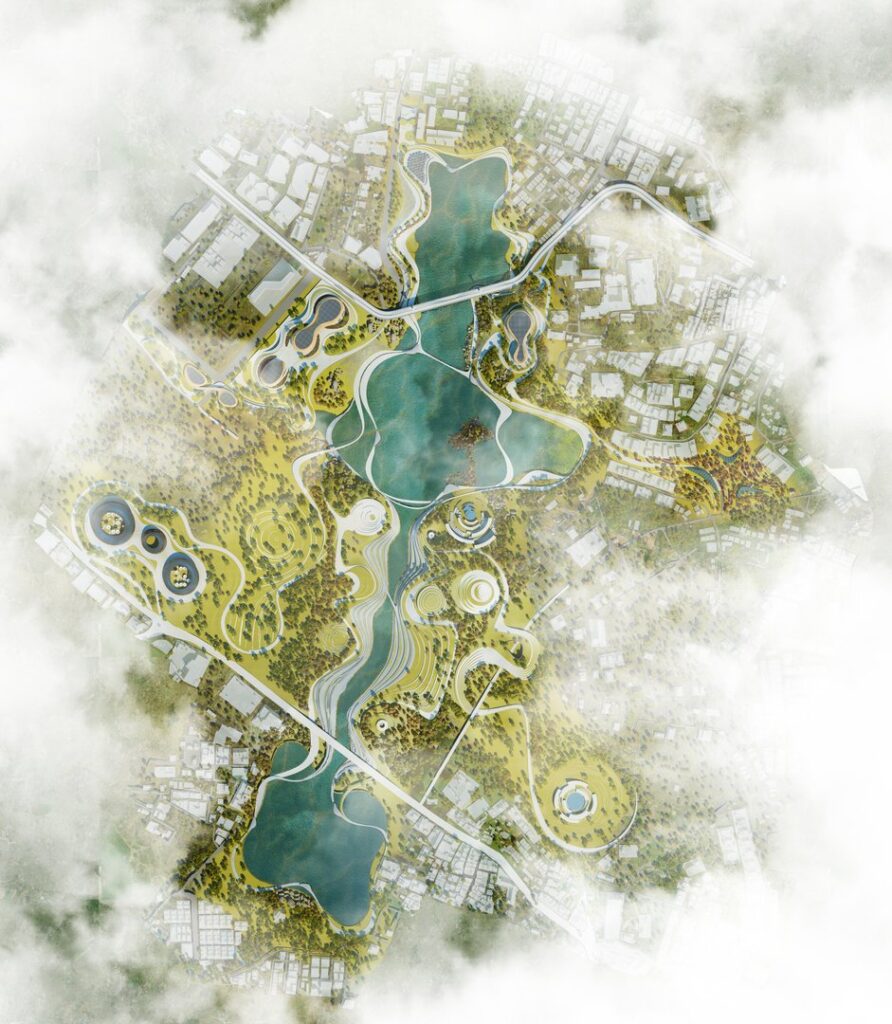
Durgam Cheruvu occupies a rare position within Hyderabad’s urban fabric. Dramatic volcanic rock formations, a broad waterfront edge, panoramic lake views, and dense green cover converge at a site already anchored by one of the city’s most recognisable landmarks — the cable-stayed bridge that spans the lake.
What is the Durgam Cheruvu urban regeneration project?
The Durgam Cheruvu regeneration is a 352.58-acre urban masterplan that repositions Hyderabad’s landmark lake as a fully activated public realm, integrating cultural institutions, ecological restoration, hospitality, and mixed-use infrastructure into a continuous lakefront landscape.
The site is defined by a rare confluence of natural elements — dramatic rock formations, expansive waterfront edges, panoramic lake views, and dense green cover — with a signature bridge that is a key landmark of Hyderabad. These attributes establish a strong ecological and visual identity, positioning the lake as a latent urban asset within the city.
Rather than imposing a new order, the masterplan works with these existing systems, preserving and amplifying the natural character of the site. The landscape becomes the primary framework, guiding spatial organisation, movement, and programme distribution.
Computational Design and AI-Driven Planning
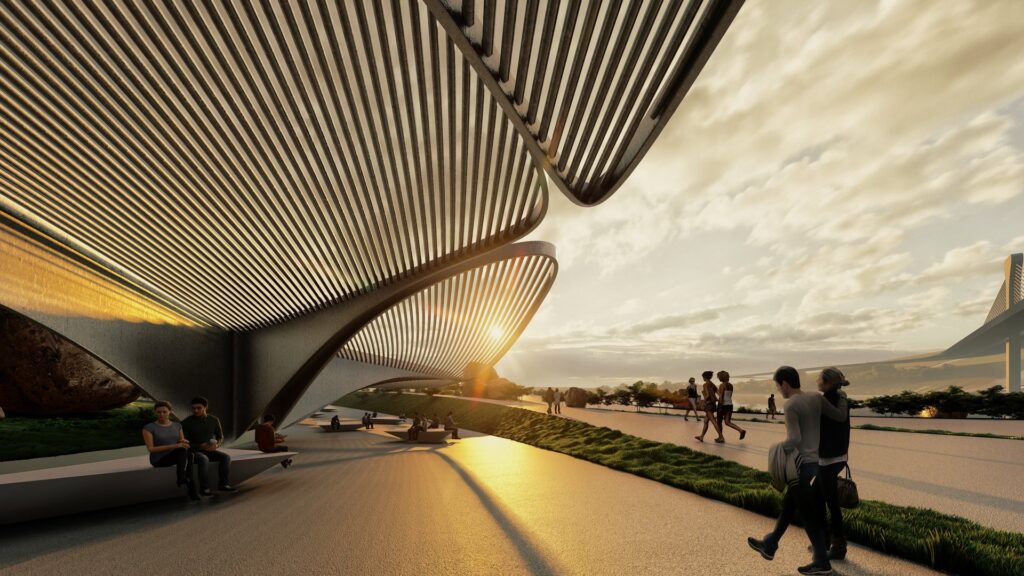
The design is rooted in the philosophy that architecture should evolve from nature and ultimately become indistinguishable from it. Drawing inspiration from the geological history of the region — where the rocks are naturally occurring as a residue of lava from ancient volcanic activity — the planning strategy uses computational processes to emulate lava flow formations and generate organic spatial patterns across the site.
How is AI used in urban masterplanning at this scale?
At Durgam Cheruvu, artificial intelligence-driven simulations were used to identify key activity nodes across 352 acres simultaneously, translating movement data and programme relationships into what Studio Symbiosis terms “programmatic vortexes” — concentrated zones of activity distributed in response to actual site conditions rather than abstract planning geometry.
These vortexes are interconnected through a fluid network of pathways and open spaces, reinforcing both movement and visual continuity.
The Masterplan: Sequence, Movement, and Programme
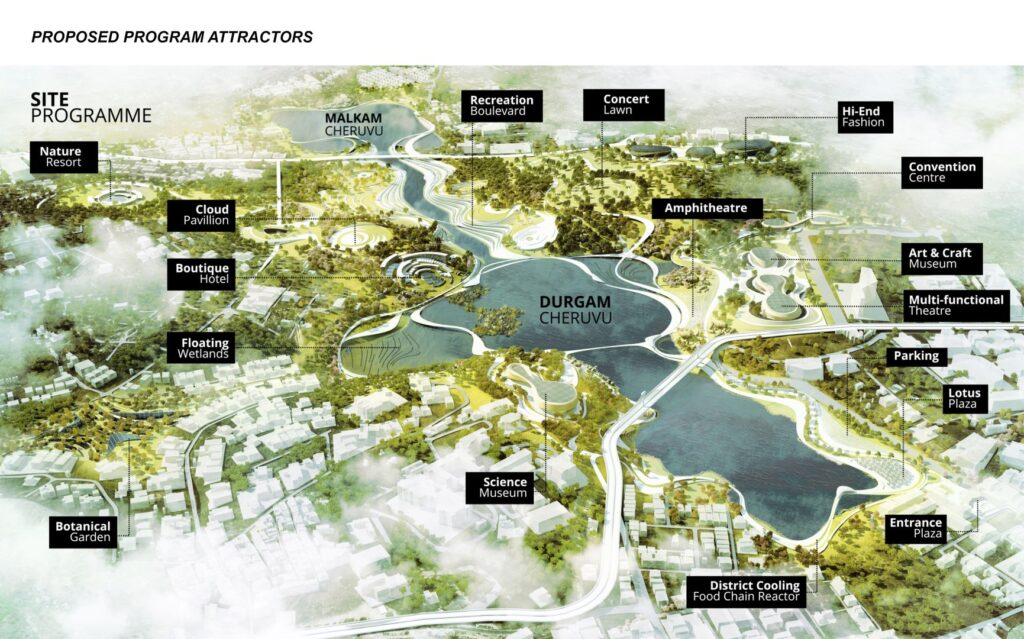
The masterplan unfolds as a sequence of interconnected experiences structured around the lake edge. Circulation is conceived as an experiential journey, with lakefront walkways forming the primary spine that connects various programme zones. Movement is not merely functional but immersive — framing views, revealing landscapes, and creating moments of pause. From shaded promenades to elevated decks and pathways carved through rock formations, the design encourages exploration and engagement at multiple scales.
The entrance experience is envisioned as a landmark moment, welcomed by the Lotus Plaza, where sculptural shading elements inspired by the national flower create a sense of arrival and openness. The gesture is both symbolic and performative — providing shade while establishing a distinct identity. The public realm is further enriched through shaded walkways, plazas, and interactive spaces that encourage gathering and social interaction.
Iconic Skyline and Canal Leisure Experience
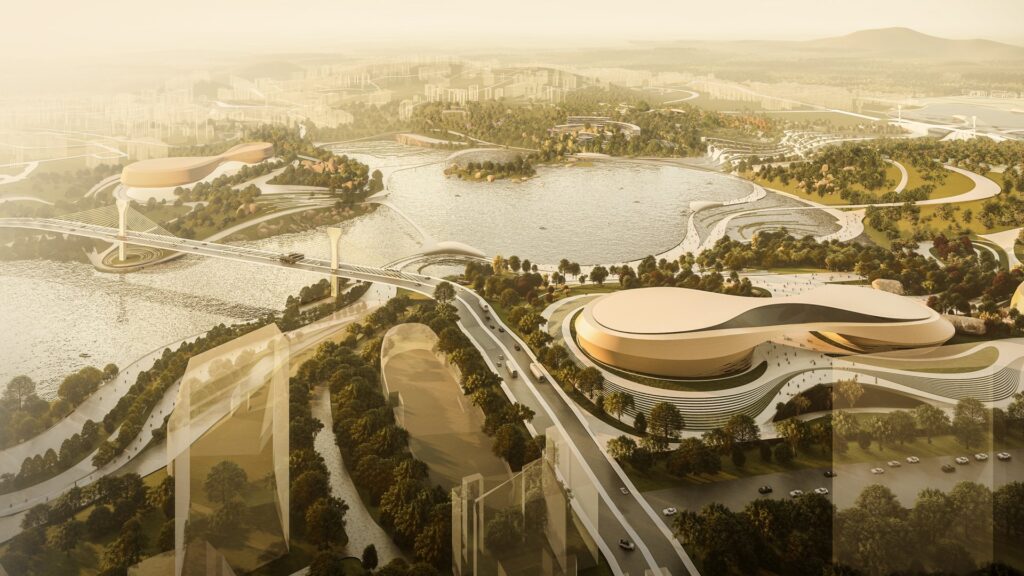
The project introduces a series of cultural institutions that collectively define a new skyline for Hyderabad. Anchored by a signature bridge over the lake — a key built element connecting a science museum at one end with a multifunctional theatre, art and craft museum, and convention centre on the other — the scheme is strategically positioned to create a strong visual and cultural identity, while framing the bridge as an iconic view across the water. The theatre and convention centre connect directly to the city side for accessibility.
Complementing this cultural spine is a series of hospitality and lifestyle experiences embedded within the masterplan. A boutique hotel with cascading pools overlooks the lake, offering an intimate and immersive engagement with the water’s edge. A nature resort allows for a quieter retreat within the larger public framework. A high-end design and retail complex — inspired by Hyderabad’s legacy of pearls — introduces a refined commercial layer, translating local cultural identity into a contemporary spatial experience.
A secondary layer of experience unfolds along the canal edge, conceived as a vibrant leisure corridor. This zone integrates retail, dining, and entertainment within a stepped landscape that negotiates level differences through terraces and platforms. The canal becomes an active social spine lined with cafés, breweries, and public spaces that extend into the landscape. Walkways interspersed with greenery create a porous edge, blurring the boundary between built and natural environments.
Living With Nature: Ecology as Programme
Beyond the urban interface, the project introduces zones that allow deeper engagement with the natural landscape. Activities such as glamping, forest bathing, rock climbing, and trekking trails are integrated within the existing terrain. These interventions are intentionally light-touch, preserving the ecological integrity of the site while enhancing its experiential richness.
A significant component of the masterplan is dedicated to biodiversity, with botanical gardens, conservatories, and floating wetlands forming a network of ecological systems. These spaces contribute to environmental restoration — improving water quality, supporting local flora and fauna, and creating microclimates across the site.
Sustainability and Infrastructure
Studio Symbiosis has approached sustainability as an integrated systems problem rather than a checklist.
The project adopts an integrated approach to sustainability, addressing water, energy, and mobility as interconnected systems. Wastewater treatment, shoreline buffers, and ecological filtration systems are introduced to restore the health of the lake. Energy strategy moves towards a net-zero aspiration, incorporating photovoltaic installations, district cooling, and efficient building systems.
Who is designing the Durgam Cheruvu regeneration?
Studio Symbiosis — the international architecture, urban design, and landscape practice with offices in Delhi NCR, Stuttgart, and London — is the design lead for the Durgam Cheruvu Urban Oasis. The project is directed by principal architects Amit Gupta and Britta Knobel Gupta, with the masterplan led by project architect Anjan Mondal.
The regeneration of Durgam Cheruvu is envisioned as more than a masterplan — it is a framework for rethinking how cities engage with their natural assets. By aligning programme, ecology, and infrastructure, the project creates a resilient and adaptive public realm that evolves with its users. It positions the lake not just as a destination, but as a living system — one that supports culture, community, and environment in equal measure.
| FACTS AND FIGURES | |
|---|---|
| Project | URBAN OASIS, REGENERATING DURGAM CHERUVU, HYDERABAD |
| Area | 352.58 ACRES |
| Status | CONCEPTUAL STAGE |
| Program | RETAIL ALONG CANAL, BOUTIQUE HOTEL, SCIENCE MUSEUM, MULTIFUNCTIONAL THEATRE, HIGH END FASHION, CONVENTION CENTRE, AMPHITEATRE, CONCERT LAWN, NATURE RESORT, BOTANICAL GARDEN, WETLANDS, ART AND CRAFT MUSEUM |
| scope and team | |
|---|---|
| Scope | MASTER PLANNING | ARCHITECTURE | LANDSCAPE |
| Design | AMIT GUPTA, BRITTA KNOBEL GUPTA, FULVIO WIRZ |
| PROJECT LEAD | ANJAN MONDAL |
| TEAM | DEWESH AGRAWAL, KARTIK MISRA, JITENDRA SAHU, CHAITANYA GOYAL, ADITYA SHARMA, HASNAIN ALAM |